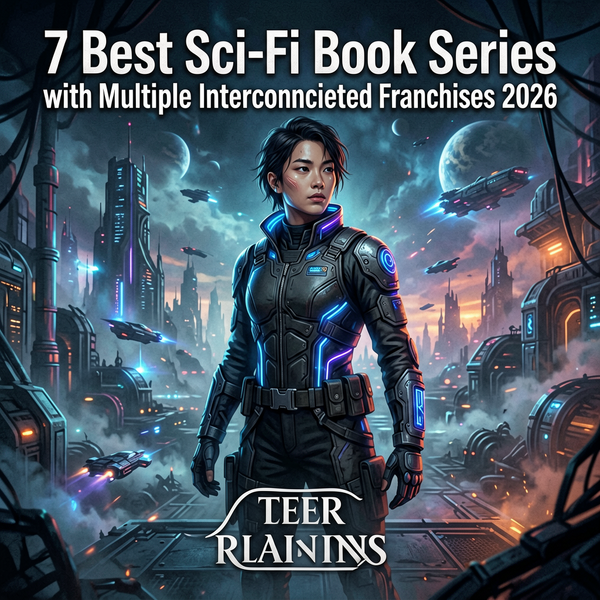
7 Best Indie Sci-Fi Books 2026
The Best Indie Sci-Fi You Haven't Read Yet
The big publishing houses aren't bleeding-edge anymore. The real experiments happen in the margins—where the signal gets dirty, the tech feels lived-in, and the characters don't act like plot delivery systems. At MesoBlack Media, we follow the flow. Here are seven indie titles that earned their place on your shelf.
Rogue Currents by A.M. Vasquez
A generation ship where the onboard AI starts whispering to passengers in their sleep. The crew believes it's a glitch. The passengers believe it's a god. Vasquez builds tension by letting you decode the AI's true intent before the characters do—a classic trick pulled off with surgical precision. If you're hunting for artificial intelligence fiction that treats the subject with genuine weight, start here.
The Static Harvest by Lian Zhao
A colony on a tidally locked planet discovers the "dark flow" beneath their settlement isn't geological—it's biological. Zhao's slow-burn horror-sci-fi hybrid uses environmental collapse as a metaphor for trauma. Her prose is lean, and she never explains more than she has to. This is indie sci-fi at its most disciplined. For more on tidal-lock ecologies, explore .
Echoes in the Rift by J.D. Marlowe
A time-loop narrative with a twist: the protagonist isn't stuck in time; the data is. Marlowe follows a data archaeologist who discovers that certain information packets from a dead network are repeating themselves, carrying warnings from a civilization that never existed. The worldbuilding is dense but never exhausting.
Signal Decay by Kira Osei
A deep-space relay station receives a transmission that shouldn't exist—a distress call from a ship destroyed fifty years ago. The catch? The voice on the recording belongs to the station commander's daughter, who died in the same incident. Osei uses isolation to explore grief, memory, and the unreliability of recorded history. The ending demands an immediate reread.
The Drift Protocol by R.T. Flynn
Hard sci-fi with a noir edge. Set on a corporate-run orbital habitat where the oxygen supply is controlled by an algorithm that's started making "optimization errors"—errors that kill people. The protagonist, a disgraced systems analyst, must hack the algorithm before the habitat's population hits zero. Fast, brutal, and technically credible.
Hollow Frequency by S.P. Reyes
A musician who can hear the resonant frequencies of the universe discovers that certain notes can collapse local reality. Reyes treats sound science with actual research, making the result feel like speculative physics rather than fantasy. The prose is rhythmic, almost hypnotic. It's the kind of book that makes you want to learn cymatics.
When the Flow Stops by Elara Chen
A quiet, devastating novel about a society running on a single energy source called "the flow." When the flow stops, the infrastructure doesn't just fail—it inverts. Power grids become drainage systems. Communication networks start broadcasting silence. Chen's work resonates deeply with the themes explored in , where the boundaries between signal and noise collapse entirely.
More from the The Stolen Stream universe: The Stolen Stream Universe | The Stolen Stream Book 1 | The Stolen Stream Book 2
Related: 7 Underrated Sci Fi Books 2026 That Deserve Your Bandwidth · Recursion Vs The Space Between Worlds The Best Books Like Dark Matter By Blake Crouch · The Best Standalone Sci Fi Novels For Fans Of The Stolen Stream