
Alvise Eschendorf: The Man Who Stole Time
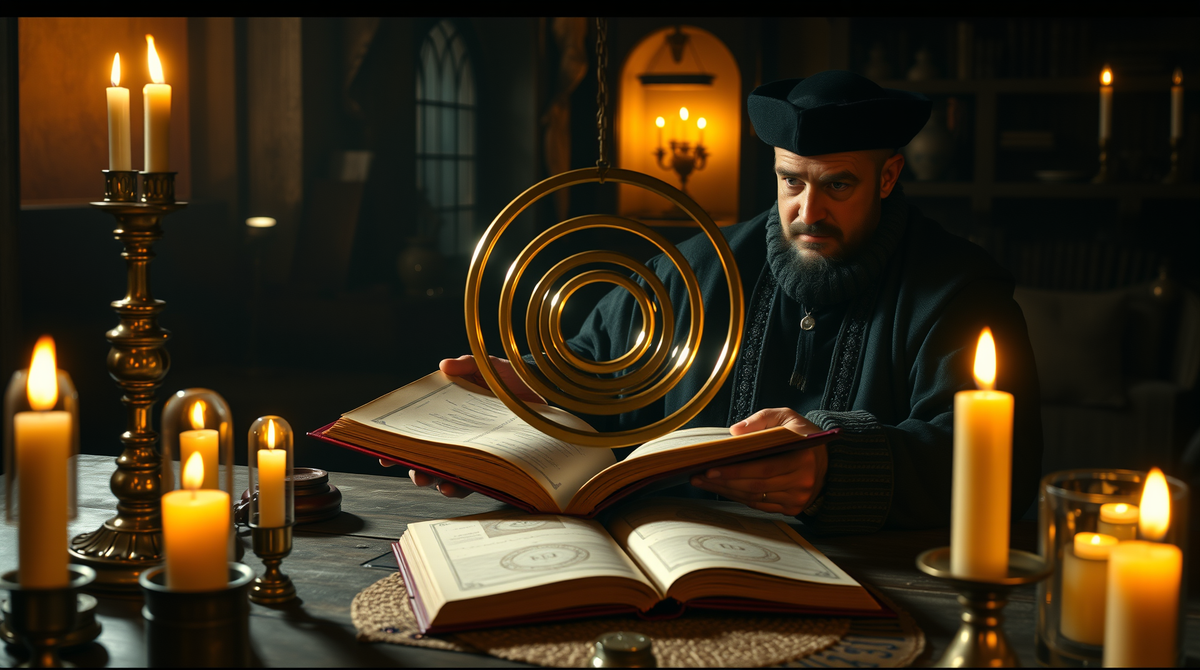
The Man Who Stole Time
The Frozen Light Singularity did not create temporal capitalism. A single act of murder did.
Alvise Eschendorf—born Matteo Eschendorf in 1588 Venice—was not an inventor. He was a thief who built an empire on a brother's corpse. Where his elder brother Luca saw the universe as a mechanism to be understood, Matteo saw it as a resource to be emptied.
Luca Eschendorf, clockmaker and natural philosopher of extraordinary talent, achieved what no human had before: he froze light at its wave-particle phase transition, creating a standing wave that could decouple local time from the universal timeline. The device—the first Frozen Light Singularity—sat in his stone workshop on a canal in Venice. Matteo visited, saw what the device could do, and made a choice.
The Murder
What happened in that workshop is not in dispute. Luca Eschendorf—true inventor, age thirty-four—was found dead. The Aetheric Pendulum and all original time-line mathematics were gone. Matteo Eschendorf—age twenty-nine—was seen leaving Venice at dawn with a locked chest. No witnesses. No investigation. The Venetian authorities were paid off.
There is a hidden compartment beneath the floorboards of that workshop where Luca's original calculations remain hidden to this day. Matteo never found them. The true entropy equations of light-based temporal manipulation—the mathematics that could have built a different world—are buried beneath a canal-side workshop that still stands in modern Venice.
The Name Change
Upon arriving in Vienna in 1591, Matteo Eschendorf became Alvise Eschendorf. He claimed the name was a tribute to an ancestor. In reality, it was erasure—he wanted no trace of the man he had killed. The name "Alvise," derived from Venetian dialect, was common among nobility. Matteo used it to reinvent himself as a legitimate businessman.
Building the Empire
Alvise spent the years 1591–1610 reverse-engineering the Aetheric Pendulum. Without Luca's original calculations, it took nearly two decades to stabilize the Frozen Light Singularity to the point where it could produce safe temporal jumps.
Once he succeeded, the timeline accelerates. He established the first stable temporal exchange rate at ten-to-one: ten days local time for one day universal. In 1601, he made his first commercial temporal jump—trading Venetian glass futures with three days of market knowledge. By 1610, he had cornered the Venetian wool trade through temporal arbitrage. By 1650, the Eschendorf family controlled the Venetian economy.
Alvise never revealed the source of his advantage. The family fortune was attributed to "generational trading wisdom." The secret was murder and stolen physics. For deeper exploration of how this single corruption shaped the entire framework of temporal society, read .
The Man Himself
Alvise was described as charming, ruthless, and patient. He could wait decades for a plan to bear fruit. He understood that time was the ultimate strategic resource—and he controlled it. He had no close friends. He married twice, both political unions. He fathered three children, all trained in the family business from childhood. Two died young—one in a temporal jump accident, one of illness. The surviving child carried the Eschendorf name forward.
To understand how Alvise's original crime calcified into the very structure of chronal society, examine the full account in .
Alvise believed that possession of the Singularity meant possession of the timeline itself. He was not wrong. The temporal capitalism we suffer today began not with a discovery, but with a betrayal. The Frozen Light Singularity did not create temporal capitalism. A single act of murder did.
More from the The Stolen Stream universe: The Stolen Stream Universe | The Stolen Stream Book 1 | The Stolen Stream Book 2
Related: Stream Sentience Time Alive Stolen Stream · Voss Jump Technician Stolen Stream · Frame Dragging And Time Dilation The Real Physics