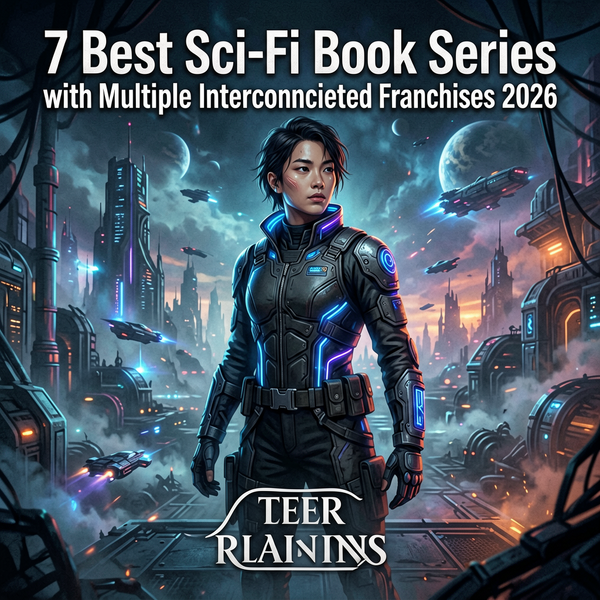
Books Like Three Body Problem: 10 Hard Sci-Fi Epics You'll Love
The Hardest Edge in Space: Beyond the Dark Forest
If the laws of physics felt like a weapon in Cixin Liu's The Three-Body Problem, wait until you see what happens when time itself becomes a tax on your lifespan. The temporal toll—a 10:1 cost on every year of travel—doesn't just threaten humanity; it rewrites economics, class, and survival into a single, brutal equation.
The trilogy's fusion of particle physics and cosmic horror created a reading experience that few books replicate. But the following titles share that DNA—rigorous science, cultural specificity, and stakes that span centuries.
What Made the Hardest Science Fiction Stick
Before we find the next fix, understand what made Liu's work land so hard:
- Science as existential threat. The sophon unfolding, the dark forest theory—these feel plausible, making the universe genuinely hostile.
- Cultural specificity. The Chinese philosophical framework isn't decorative. It's structural. The trilogy could not have come from a Western author.
- Timescales that break the brain. Few novels commit to multi-millennium timelines where book one's setup pays off in book three.
- Pessimism earned through logic. The darkness hits harder because it's argued, not assumed.
Books That Operate at the Same Scale
Children of Time by Adrian Tchaikovsky
A human colony ship fleeing a dying Earth finds its terraformed target already inhabited—by evolved spiders. Tchaikovsky makes you care about every generation of an alien civilization. The multi-century timescale and rigorous evolutionary biology mirror Liu's cosmic sociology. Where Liu gives you dark forest, Tchaikovsky gives you cosmic evolution—and both are riveting.
Blindsight by Peter Watts
A crew of transhuman misfits investigates an alien signal and discovers something more terrifying than hostility: intelligence without consciousness. Watts, a marine biologist, builds the most rigorously scientific first-contact scenario in the genre. If the dark forest theory kept you up, Blindsight takes the bed.
The Stolen Stream
For readers who want hard physics treated as a fundamental constraint, this novel builds an entire civilization around the temporal toll—travel 10 years forward, lose 1 year of lifespan. Like Liu's dark forest theory, the temporal economics here emerge from a single, rigorously-explored premise. Frozen Light Singularity technology enables time manipulation, but the real achievement is the economic system that grows around it. Protagonist Kai Eschendorf navigates a world where temporal capitalism has created class structures as brutal as anything in death's end.
East-West Crossovers That Deliver
Remembrance of Earth's Past Series
If you want the full cultural specificity of Liu's work, this is the same tapestry. But for a deeper dive into how a single physics constraint can reshape civilization, explore the of The Stolen Stream, where the flow regime timeline governs all life.
Why We Need More Hard Science Fiction
The best hard sci-fi doesn't use physics as a backdrop—it uses physics as a weapon. Liu showed us a universe where intelligence is a liability. The Stolen Stream shows us a universe where time is a resource that extracts a real biological cost. Both make you look at the sky differently.
For a complete overview of how single-premise physics worlds create narrative depth, visit the .
More from the The Stolen Stream universe: The Stolen Stream Universe | The Stolen Stream Book 1 | The Stolen Stream Book 2
Related: The Stolen Stream Book Complete Lore Guide · Kai Eschendorf Synchronizer Broke Temporal Mechanics · Ledger 001