The Stolen Stream Book: Why Hard Sci-Fi Needs Industrial Body Horror
The Body as the Price of Transit
Time travel in The Stolen Stream isn't a clean equation—it's a violation inscribed in bone and sinew. Every jump exacts tissue, rewrites biology without consent, and leaves technicians reading their own cellular damage like a failing dashboard. This isn't sanitized engineering; it's industrial body horror, the only honest language for a universe that charges interest on borrowed time.
The 10:1 toll isn't abstract—it's calcification, nerve death, cellular erasure. Technicians aren't operators; they're organs of the machine, learning to parse their own degradation as if reading a failing log. Anthony Frederick's work refuses the surgical workaround: no pill offsets the toll, no shielding protects the traveller. The Stream isn't a portal—it's an ancient, poorly understood machine housed in brutalist concrete bunkers, maintained by people who don't fully grasp what they service. They learn to feel when the Stream is observing them rather than simply transporting them.
For a deeper look at how technicians decode the Stream's patterns, trace the cellular damage maps and the layered realities complicating every jump in .
When Travel Hurts
The horror compounds, not in dramatic bleeds but in cellular forgetfulness—time erasing the body from the inside. Frederick anchors every transit in tangible cost. The Stream doesn't transport; it metabolizes. Technicians emerge older, weaker, their bodies bearing the geometric scars of recursive transit. The toll isn't random—it follows patterns that suggest intent, a logic that refuses to be fully mapped. Every technician who survives long enough learns their own degradation signatures, reading their failing synapses as if they were instrumentation.
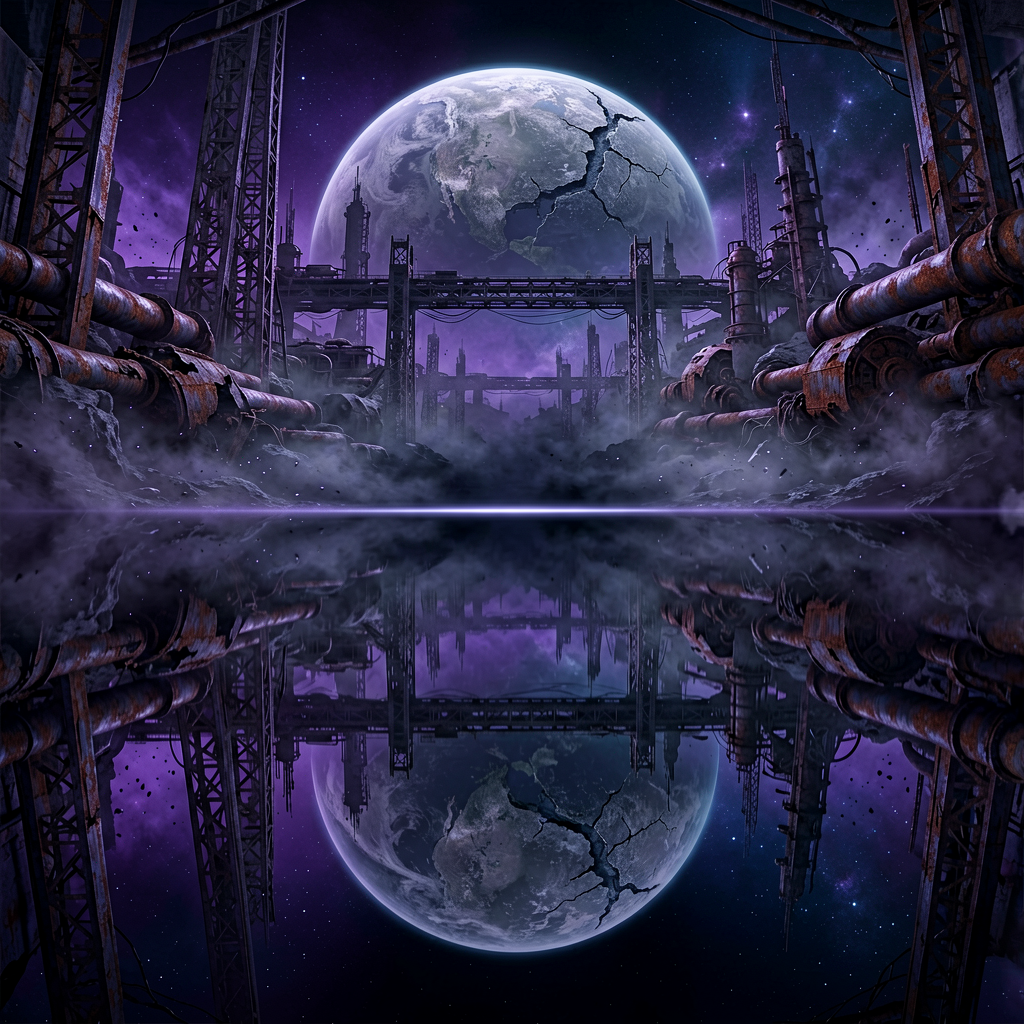
The aesthetic reinforces the dread. No neon gleam, no gleaming cybernetics. The facility hums with exposed cryogenic lines and capacitor banks at sub-audible frequencies. Tools are analog—dials, switches, physical override levers. The horror lives in the friction between obsolete hardware and incomprehensible physics. Technicians maintain the machinery the Stream chose, not the machinery they designed. They patch, they jury-rig, they pray their repairs hold.
Explore the rules governing time's price and the pattern that demands payment in .
Industrial, Not Slick
Hard sci-fi often polishes its edge into decorative steel. The Stolen Stream leaves the edge raw and rusted. The Stream charges interest on every transit, and no technician fully maps the toll's logic. What they build—the diagnostic frameworks, the cellular damage maps, the recursive transit logs—are monuments to partial understanding, scaffolding erected around a void.
This is hard sci-fi that refuses to admire its own cleverness. It asks what it costs to be clever in a universe that never agreed to be understood. The body isn't an interface; it's a payment. The machine doesn't answer; it exacts. The technician doesn't pilot; they endure.
For a wider look at the infrastructure of time, the currents that flow between jumps, and the cost no technician escapes, see the full .
More from the The Stolen Stream universe: The Stolen Stream Universe | The Stolen Stream Book 1 | The Stolen Stream Book 2
Related: Event Horizon Lullaby Opening Theme · Chronometers Echo Tick Of Stolen Time · Chronometers Echo The Tick Of Stolen Time