Temporal Capitalism Technical Whitepaper
The Frozen Light Singularity — A Machine That Steals Time
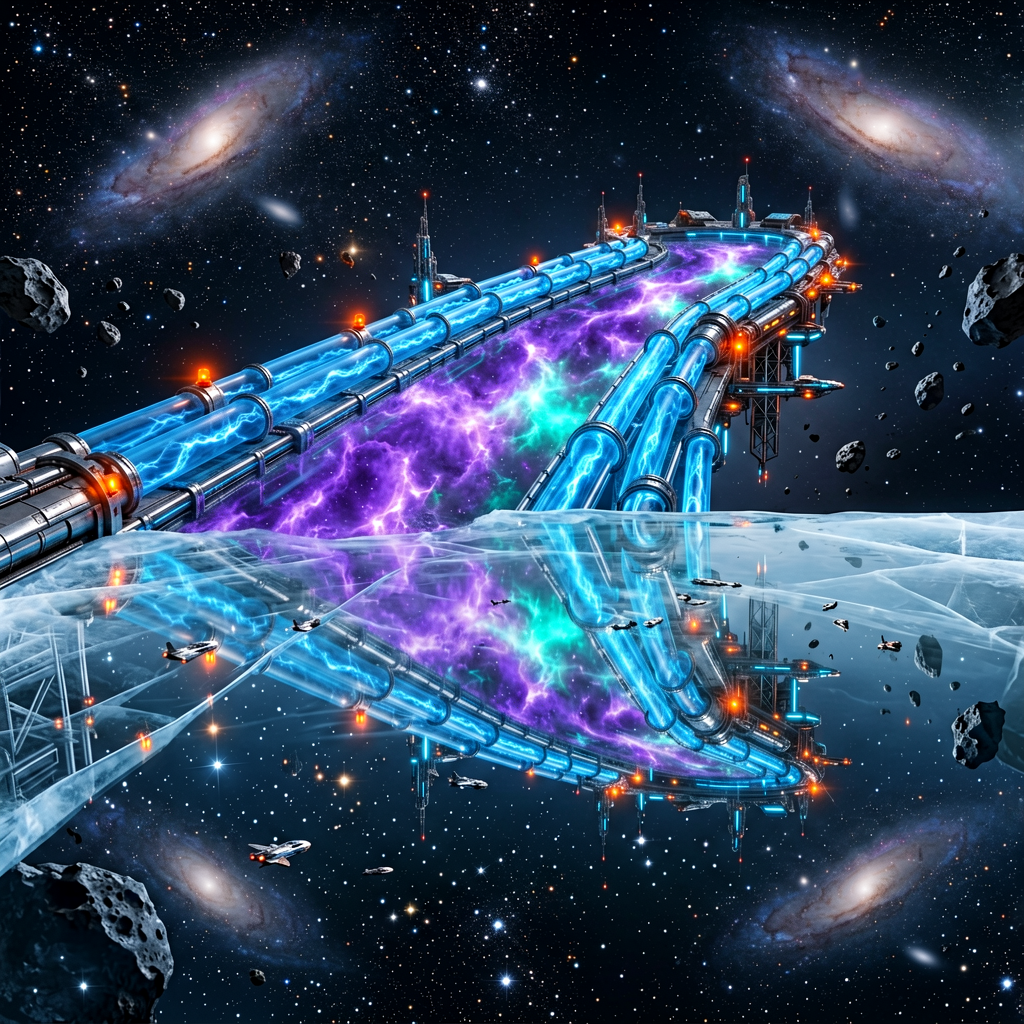
In 1588 Venice, a clockmaker named Alvise Eschendorf discovered that light could be frozen at the threshold between wave and particle. That discovery became the Frozen Light Singularity — a machine that does not merely bend time, but commodities it. Temporal Mechanics is not metaphor. It is physics.
The Mechanism of Temporal Decoupling
The Singularity operates by creating a standing wave of frozen light that decouples local time from the universal timeline. Within this field, the Second Law of Thermodynamics becomes negotiable. Entropy can decrease. Time can be drawn from one region and deposited in another, like electricity through a wire — a process called chronal conduction. The system is locked to a specific frequency derived from Earth's geomagnetic field in 1588: 7.83 Hz, the Schumann resonance of that moment. This locking frequency determines everything that follows. It cannot be altered without destroying the Singularity entirely.
Each temporal jump requires approximately 4.7 × 10¹⁵ Joules — the output of a small nuclear reactor for a full day. That energy is not burned from fuel. It is drawn from the temporal gradient itself, creating a feedback loop that powers subsequent jumps. The machine feeds on the difference it creates.
The Signal Tax — Thermodynamics of Time Debt
The toll emerges from the cost of violating causality. For every 10 years of temporal displacement, the traveler loses 1 year of biological lifespan. This is not aging. It is direct subtraction from total available metabolic time — a permanent, irreversible consumption that no known mechanism within the universe can restore.
The ratio is not arbitrary. It is determined by the fine-structure constant of temporal conductivity within the Singularity's locked frequency:
- Base frequency: 7.83 Hz
- Temporal conduction coefficient: α_t = 0.127
- Resulting toll ratio: 1/α_t ≈ 7.87 ≈ 10:1
If the Singularity were built elsewhere or at another time, the toll would differ. It is locked to a specific geophysical fingerprint — 1588 Venice — and cannot be renegotiated.
The cumulative cost is staggering. Kai Eschendorf, the protagonist of The Stolen Stream, has made enough jumps over 437 subjective years to owe a toll that exceeds a single human lifespan several times over. His body is preserved at age 28 through temporal stasis, but his biological clock is nearly empty. He is a walking debt.
Frame-Dragging and Biological Drift
When a temporal jump occurs, it creates a wake in spacetime — frame-dragging — that drags nearby objects and observers into the stream. This is not a side effect. It is a feature of the system. The Singularity cannot fire without pulling something else along with it. The stolen years of others accumulate as drift in the traveler's biological signature, creating mismatches that compound with every jump.
This is not a superpower. It is a horror system built on irreversible consumption. Temporal Mechanics does not create value. It extracts it from the traveler's own lifespan, then charges interest in the form of frame-dragged debris from every stolen moment.
The Frozen Light Singularity is a machine that eats the future to fuel the past. And it is not done feeding.
More from the The Stolen Stream universe: The Stolen Stream Universe | The Stolen Stream Book 1 | The Stolen Stream Book 2
Related: 10 1 Temporal Toll Physics · Books Like Three Body Problem · The Stolen Stream Book Complete Lore Guide