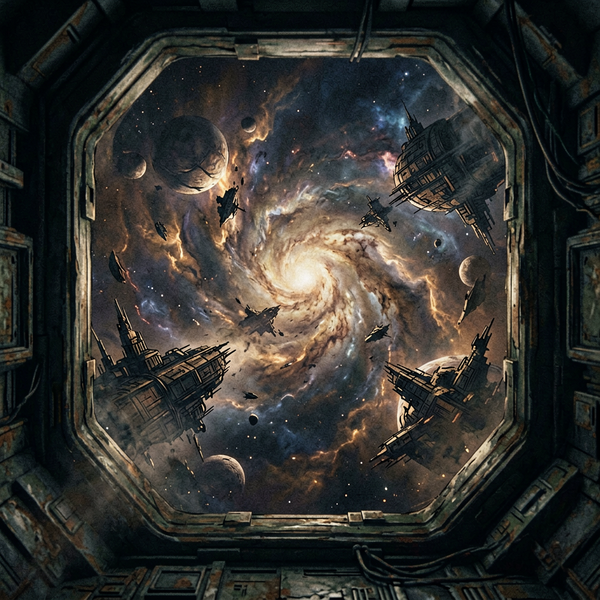
The Stolen Stream Book — Complete Lore Guide to Temporal Capitalism and the Eschendorf Dynasty

The Stolen Stream: Temporal Mechanics and the Eschendorf Dynasty
Time itself has been weaponized. In the universe of The Stolen Stream, a single family dynasty has extracted 8.4 million years of life through the Distributed Toll, and a 437-year-old heretic named Kai Eschendorf is building a device that could shatter the architecture of temporal capitalism entirely.
This is hard sci-fi built on debt, physics, and the Frozen Light Singularity—a world where the flow of time is no longer a natural constant but a commodity traded, stretched, and stolen.
The Frozen Light Singularity — The Event That Broke Time
In 1588, a clockmaker named Thomas Harrow built the first Frozen Light Singularity in his Italian monastery workshop. He was trying to construct a clock that would never need winding. Instead, he created a device that arrested causality itself—a pocket of frozen time that would endure for centuries.
The Singularity trapped his daughter Anne at the age of nine for 438 years. She remained alive but motionless in that chamber while the Eschendorf dynasty rose to power around her. Brother Matteo spent 40 years attempting to free her, only to be executed by Consortium agents in Anne's frozen state became the symbol of what temporal capitalism does to ordinary people: steal their time and call it progress.
Temporal Mechanics — The Signal Tax
The core economic engine of this universe is temporal capitalism—a system where time serves as the fundamental currency. Julian Eschendorf, known as the Architect, perfected the Distributed Toll: a 10:1 extraction ratio that takes ten years of subjective lifespan from the payer for every one year delivered to the elite.
The mechanism operates through the Dilation Array, a network of chronal amplifiers that stretches the Stream—the temporal flow—across population centers, creating zones where time passes at different rates for different classes. Julian's refinement, the Distributed Toll, spreads the extraction burden across millions of payers so no single withdrawal proves fatal, yet the aggregate yield remains staggering: 8.4 million years extracted over six centuries.
The underlying structure is the Chronal Lattice, the grid over which time flows. The Dilation Array warps this lattice, compressing and stretching temporal reality. But there is a limit. The Great Snap-Back represents the theoretical threshold where an overstretched lattice snaps back with catastrophic consequences. The Validation Ring—a calibration device used to measure lattice integrity—reveals cracks long before the Snap-Back arrives. The Eschendorfs have ignored these warnings for generations.
For a deeper exploration of how the Stream was first financialized, see .
Kai Eschendorf — The Man Who Built the Synchronizer
Kai Eschendorf is 115 years old biologically, 437 chronologically. Born into the dynasty that perfected temporal capitalism, he rejected it. His mother, Selene Eschendorf, suffered from Temporal Fragmentation—a condition caused by repeated exposure to the Dilation Array's distortions. Kai watched her mind dissolve across multiple time streams, and that loss drove him to build the Synchronizer, a heretical device designed to recalibrate the Chronal Lattice and dismantle the Distributed Toll.
The Synchronizer threatens the Eschendorf dynasty's control over the Stream itself. If Kai succeeds, the architecture of temporal capitalism collapses—and with it, 8.4 million years of stolen life. To understand the full scope of Kai's rebellion and the dynasty's response, explore .
The Stolen Stream is not a story about escaping time. It is a story about taking it back.
More from the The Stolen Stream universe: The Stolen Stream Universe | The Stolen Stream Book 1 | The Stolen Stream Book 2
Related: Kai Eschendorf Synchronizer Broke Temporal Mechanics · Ledger 001 · The Synchronizer Heretical Compass Stolen Stream